


IRS Qualified Business Income Deduction: What It Is & Who Qualifies
If you run a small business, freelance, or earn 1099 income, you've probably heard you can deduct 20% of your business income before you even start listing expenses. That's the IRS qualified business income deduction, and most self-employed filers either skip it entirely or claim it wrong. Neither mistake is cheap when you're leaving money on the table or inviting an IRS notice.
The QBI deduction, created under the Tax Cuts and Jobs Act, lets eligible owners of sole proprietorships, partnerships, S-corps, and certain trusts deduct up to 20% of qualified business income on their personal return. It sounds simple until you factor in taxable income thresholds, wage limits, and the specified service trade or business rules that trip up doctors, lawyers, and consultants every filing season.
We prepare Schedule C, LLC, and S-Corp returns every day at TaxesToday, and QBI questions come up constantly. This article breaks down exactly what qualifies as business income, who can claim the deduction, how the calculation actually works, and how to report it correctly on Form 8995 or Form 8995-A depending on your income level.
Why the QBI deduction matters for your tax bill
Money is the whole point here. The qualified business income deduction can shave thousands off your taxable income without you spending a dollar on new equipment, hiring, or any other deductible expense. If you're a freelancer who nets $80,000 from Schedule C work, a straightforward QBI deduction knocks $16,000 off your taxable income before you even apply the standard deduction. That's not a credit that phases out or a deduction you have to itemize for. It's a flat 20% reduction available to sole proprietors, partners in a partnership, S-corp shareholders, and even some trust and estate beneficiaries.

The real dollar impact
Consider two freelance graphic designers who each earn $70,000 in net self-employment income. One knows about QBI and claims it. The other doesn't and just takes the standard deduction. At a 22% marginal federal rate, the difference is roughly $3,080 in tax savings for the filer who claims the deduction correctly. Multiply that gap across five, ten, or twenty years of self-employment, and you're looking at tens of thousands of dollars that either stays in your pocket or gets handed to the IRS unnecessarily.
Skipping the QBI deduction on eligible income is like leaving a 20% tip on your tax bill for no reason.
We see this constantly at TaxesToday. Clients come to us for a second opinion on a self-prepared return, and the QBI deduction is either missing entirely or calculated incorrectly because the software didn't account for wage limitations or SSTB status. Both errors cost money, just in opposite directions. Missing it means overpaying. Miscalculating it means risking an IRS notice down the line.
Who feels the biggest effect
Self-employed workers and small business owners feel this deduction the most because they don't get the payroll withholding cushion that W-2 employees have. Every dollar of net business income is fully exposed to income tax, and for many, self-employment tax on top of that. The QBI deduction is one of the few tools available specifically to owners of pass-through entities, meaning the business income flows through to your personal return instead of being taxed at a separate corporate rate.
Here's how the deduction typically plays out across common business structures, assuming taxable income stays under the 2025 thresholds where wage and SSTB limits kick in:
| Business Type | Example Net Income | Potential QBI Deduction (20%) | Approximate Tax Savings (22% bracket) |
|---|---|---|---|
| Sole proprietor (Schedule C) | $60,000 | $12,000 | $2,640 |
| Single-member LLC | $90,000 | $18,000 | $3,960 |
| S-corp shareholder (K-1 income only) | $100,000 | $20,000 | $4,400 |
| Partnership (K-1 income) | $120,000 | $24,000 | $5,280 |
These numbers assume you're under the taxable income threshold for 2025 ($197,300 for single filers, $394,600 for married filing jointly), where the full 20% deduction generally applies without wage or SSTB complications. Above those thresholds, the math gets more layered, which we cover in the calculation section below.
The cost of getting it wrong
Beyond the missed savings, there's a compliance angle that a lot of filers overlook. Claiming QBI on income that doesn't qualify, like wages from a job where you're actually an employee misclassified as a contractor, or capital gains mistakenly lumped in as business income, can trigger an IRS notice. We handle these notices regularly for clients who filed on their own or used a preparer who didn't specialize in self-employment returns. Correcting a bad QBI claim after the fact usually means filing an amended return with Form 1040-X, which takes time and sometimes triggers additional scrutiny.
Getting the deduction right the first time protects both your refund and your peace of mind. It also matters more every year the thresholds shift with inflation, since a filer who qualified for the full deduction last year might land in a phase-out range this year without realizing it. That's exactly why understanding the qualification rules, which we walk through next, matters just as much as knowing the deduction exists in the first place.
How to qualify for the QBI deduction
Qualifying for the QBI deduction starts with one basic requirement: you need pass-through business income, not wages. That means income from a sole proprietorship, partnership, S-corp, or certain trusts and estates counts, while a W-2 paycheck never does, even if you also freelance on the side. Rental property income can qualify too, but only if the activity rises to the level of a trade or business under IRS guidelines, which usually means regular, continuous, and substantial involvement rather than a single property you rent out twice a year.
Business structures that qualify
Most of our clients at TaxesToday fall into one of these categories, and each one has a slightly different reporting path even though the underlying 20% math stays the same:
- Sole proprietors reporting income on Schedule C
- Single-member LLCs taxed as disregarded entities (also Schedule C)
- Partnerships passing K-1 income to partners
- S-corporations passing K-1 income to shareholders
- Certain trusts and estates with qualifying business activity
Notice that C-corporations are absent from that list. If your business is taxed as a C-corp, you're out of QBI territory entirely, since that structure already gets its own corporate tax treatment.
Income thresholds that control your deduction
Your taxable income determines how much of the deduction you actually get to keep. Below the 2025 threshold, $197,300 for single filers and $394,600 for married filing jointly, you generally claim the full 20% without worrying about wage limits or business type. Cross that line, and two more factors kick in: the W-2 wages and qualified property your business pays or owns, and whether your business is classified as a specified service trade or business, which we cover in detail in the next section.
If your taxable income sits under $197,300 (single) or $394,600 (married), qualifying for QBI is usually as simple as reporting the income correctly.
What disqualifies income from QBI treatment
Not every dollar that touches your business return counts as qualified business income. The IRS specifically excludes certain items, and missing this distinction is one of the most common errors we correct during a tax return review:
- Wages you pay yourself as an S-corp employee
- Guaranteed payments to partners
- Capital gains or losses from selling business property
- Interest income not connected to the business
- Dividend income
- Income earned outside the United States
Getting this list right matters because overclaiming QBI on excluded income is exactly the kind of error that draws an IRS notice. Once you've confirmed your business structure qualifies and your income falls into the right category, the next step is running the actual calculation, which changes depending on where your taxable income lands relative to those thresholds.
How to calculate your QBI deduction
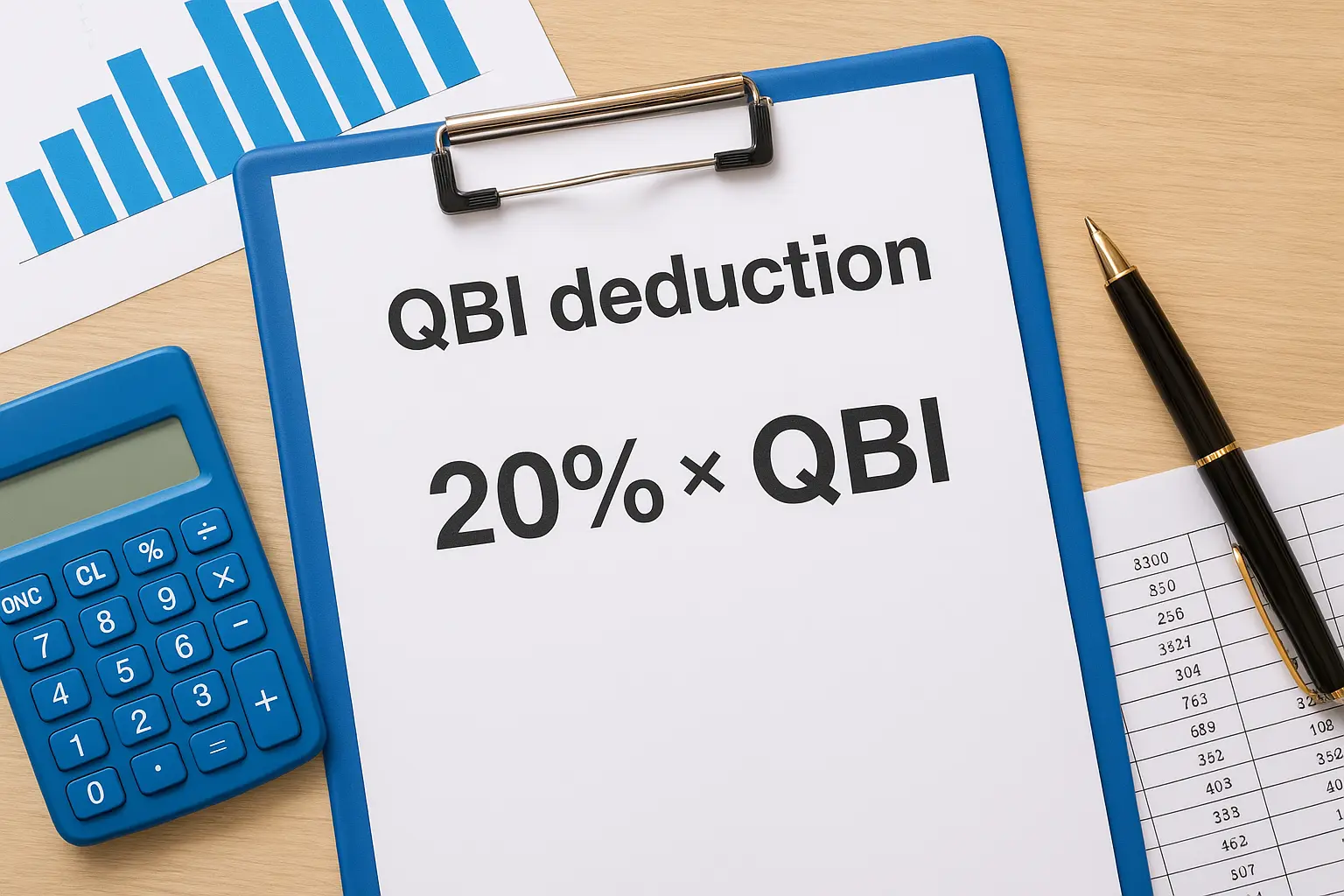
Calculating the QBI deduction works differently depending on where your taxable income falls, so the first step is always figuring out which formula applies to you. Below the threshold, the math is almost embarrassingly simple. Above it, you're running two separate limitations and taking whichever number is smaller. Either way, the deduction is calculated on qualified business income, not gross revenue, so you subtract your business expenses first and only apply the 20% to what's left.
The simple calculation below the threshold
Giuseppe below the income cap, you take 20% of your qualified business income, full stop. If your Schedule C shows $85,000 in net profit after expenses, your QBI deduction is $17,000. The IRS also caps the deduction at 20% of your taxable income minus net capital gains, so most filers with straightforward W-2-free income never hit that secondary limit, but it's worth knowing it exists.
Below the threshold, your QBI deduction is simply 20% of net business profit, no wage math required.
The wage and property limitation above the threshold
Once your taxable income crosses $197,300 (single) or $394,600 (married filing jointly) for 2025, the deduction gets capped at the greater of two amounts:
- 50% of the W-2 wages your business paid during the year, or
- 25% of W-2 wages plus 2.5% of the unadjusted basis of qualified property (think equipment, real estate used in the business)
You then compare that wage limit to the straight 20% calculation and claim whichever is lower. This is exactly why S-corp owners who pay themselves a reasonable salary sometimes come out ahead of sole proprietors with identical net income but zero W-2 wages paid.
A worked example
Here's how the numbers shift for a consulting business with $250,000 in qualified business income, comparing a sole proprietor to an S-corp paying $60,000 in W-2 wages:
| Scenario | 20% of QBI | 50% of W-2 Wages | Allowed Deduction |
|---|---|---|---|
| Sole proprietor, $0 wages paid | $50,000 | $0 | $0 (limited to wage test) |
| S-corp, $60,000 wages paid | $50,000 | $30,000 | $30,000 |
Notice the sole proprietor loses the deduction entirely above the threshold with no W-2 wages paid, while the S-corp structure preserves a meaningful chunk of it. This single difference is why we spend so much time with clients weighing entity structure once income starts climbing past six figures.
Don't forget the overall income limitation
Even after you run the wage test, the deduction can't exceed 20% of your total taxable income minus net capital gains, including qualified dividends. This rarely limits filers with modest investment income, but if you had a big capital gain year alongside strong business profit, it's worth double-checking before you finalize the number. Once you've landed on the correct figure, the next step is reporting it properly on your return.
How to claim the QBI deduction on your tax return
Reporting your QBI deduction comes down to picking the right form, and the IRS gives you two options depending on your taxable income. Form 8995 is the simplified version, and most filers under the 2025 thresholds of $197,300 (single) or $394,600 (married filing jointly) use this one-page form without ever touching the wage and SSTB calculations. Above those thresholds, you're required to file Form 8995-A, which walks through the wage limitation, the specified service trade or business phase-out, and multiple worksheets depending on how many businesses you own.
Choosing between Form 8995 and Form 8995-A
Your taxable income before the QBI deduction is what decides which form you use, not your gross revenue or your business structure. Here's a quick side-by-side to keep the two straight:
| Factor | Form 8995 | Form 8995-A |
|---|---|---|
| Taxable income | Under $197,300 single / $394,600 MFJ | Above those thresholds |
| Complexity | One page, no wage math | Multiple schedules, wage and SSTB limits apply |
| SSTB income | Fully allowed if under threshold | Phased out or eliminated above threshold |
| Multiple businesses | Simple aggregation | Requires Schedule A, B, or C attachments |
Using the wrong form doesn't just create paperwork headaches. Filing Form 8995 when you should have used 8995-A means the IRS may recalculate your deduction and send a notice adjusting your refund or balance due.
Information you need before you start
Gathering the right numbers ahead of time keeps this from turning into a scramble in April. Before filling out either form, pull together:
- Net profit or loss from each Schedule C, K-1, or trust
- W-2 wages paid by each business, if applicable
- Unadjusted basis of qualified property (equipment, real estate)
- Your total taxable income before the QBI deduction
- Documentation showing whether any business qualifies as an SSTB
Missing even one of these figures, especially W-2 wages for an S-corp owner near the threshold, forces you to redo the math after the fact.
Where the deduction lands on your 1040
Once you've completed Form 8995 or 8995-A, the final deduction amount flows to line 13 of Form 1040, reducing your taxable income directly. It's a below-the-line deduction, meaning it doesn't lower your adjusted gross income or affect eligibility for other AGI-based credits and phaseouts. That distinction matters if you're also claiming things like the Child Tax Credit or education credits, since those calculations use AGI, not taxable income after QBI.
The QBI deduction reduces taxable income on line 13 of Form 1040, but it never touches your AGI.
We run into filers every season who completed the QBI form correctly but then transposed the number incorrectly onto their 1040, or who claimed it on the wrong line entirely when filing by hand. Software generally handles this transfer automatically, but if you're preparing your own return with paper forms or a spreadsheet, double-check that line 13 matches your Form 8995 or 8995-A output exactly before you file. Getting the form right and getting the transfer right are two separate steps, and both matter equally when the IRS is comparing your return against its own records.
Special rules for specified service trades or businesses
Some businesses face extra restrictions on the QBI deduction simply because of what they do. The IRS calls these specified service trades or businesses, or SSTBs, and the list covers fields where the business's main asset is the reputation or skill of its owners and employees. If you're a doctor, lawyer, accountant, consultant, financial advisor, or run a business in performing arts, athletics, or investment management, you're almost certainly looking at an SSTB. Below the taxable income threshold, none of this matters. Your business gets the full 20% deduction whether it's an SSTB or not. The rules only bite once your taxable income climbs past $197,300 (single) or $394,600 (married filing jointly) for 2025.

Which businesses count as an SSTB
The IRS defines the SSTB category broadly, and the list trips up more business owners than you'd expect. Common SSTB fields include:
- Health (doctors, dentists, physical therapists)
- Law
- Accounting
- Financial services and investment management
- Consulting
- Performing arts and athletics
- Actuarial science
Notably, engineering and architecture were carved out as exceptions and don't count as SSTBs, even though they're professional service fields that feel similar on paper. This carve-out surprises a lot of architects and engineers who assume they're automatically excluded.
The phase-out range
Once your taxable income exceeds the threshold, your SSTB deduction doesn't disappear all at once. It phases out over a range of $50,000 for single filers and $100,000 for married filing jointly. Inside that range, you calculate a reduced percentage of both your qualified business income and your W-2 wages, then run the same wage limitation test described earlier using those reduced figures. Once your taxable income exceeds the top of the phase-out range, roughly $247,300 for single filers and $494,600 for married filing jointly in 2025, the SSTB deduction drops to zero entirely, no matter how much you paid in wages.
Above the phase-out ceiling, an SSTB owner gets zero QBI deduction, while a non-SSTB business with identical income can still claim a substantial chunk.
Why entity structure matters more for SSTBs
We've had consultants and financial advisors come to us assuming their QBI deduction just vanished once they crossed into six-figure taxable income, and that's often only half true. If you're in the phase-out range rather than above it, a partial deduction is still on the table, and restructuring how you pay W-2 wages can sometimes preserve more of it. This is exactly the kind of calculation we run during a tax return review, since the difference between assuming you get nothing and actually calculating the phase-out percentage can mean thousands of dollars. The IRS outlines the full mechanics of this phase-out in its official guidance on the qualified business income deduction, and it's worth reviewing if your income sits anywhere near these thresholds.
QBI deduction examples for common business types
Numbers make this deduction click faster than any rule ever will. Walking through actual scenarios shows how the same 20% rate produces wildly different outcomes depending on entity structure, wages paid, and whether the business trips the SSTB rules covered above. Below are four situations we see constantly at TaxesToday, each one representative of a client type that comes through our door every filing season.

Freelance photographer on Schedule C
Suppose a wedding photographer nets $65,000 after equipment, travel, and editing software expenses, with total taxable income of $58,000 after the standard deduction. She's well under the 2025 threshold, so the calculation is pure and simple: 20% of $65,000 equals a $13,000 QBI deduction, claimed on Form 8995 with no wage math involved. Photography isn't an SSTB, so none of the phase-out rules apply even if her income climbed higher.
Single-member LLC with rental property income
A landlord running a single-member LLC with three rental properties nets $40,000 after depreciation and expenses, and the activity is substantial enough to count as a trade or business under IRS safe harbor guidance. That qualifies him for a $8,000 deduction (20% of $40,000), reported the same way as any other Schedule C-style pass-through. The key detail here is proving the rental activity rises to trade-or-business status, since casual landlords with one property and minimal involvement often don't clear that bar.
S-corp shareholder above the threshold
An IT consultant runs her business as an S-corp, pays herself a $70,000 reasonable salary, and the business nets $220,000 in additional profit passed through on a K-1. Her taxable income puts her above the $197,300 single threshold, so the wage limitation applies. Here's how the comparison plays out:
| Test | Calculation | Result |
|---|---|---|
| 20% of QBI | 20% × $220,000 | $44,000 |
| 50% of W-2 wages | 50% × $70,000 | $35,000 |
| Allowed deduction | Lesser of the two | $35,000 |
Paying yourself a reasonable W-2 salary through an S-corp can protect your QBI deduction even after your income crosses the threshold.
Two-partner consulting firm
A two-partner marketing consulting firm generates $300,000 in combined qualified business income, split evenly via K-1s, with $80,000 in total W-2 wages paid to staff. Marketing consulting isn't automatically an SSTB unless the work leans into strategic advice rather than creative or advertising services, so this firm often clears SSTB concerns entirely. Each partner reports $150,000 in QBI and $40,000 in allocated wages, running the same wage limitation test individually on Form 8995-A. These examples share one lesson: the deduction rewards businesses that pay real wages and keep clean records, which is exactly why entity structure conversations matter so much once income starts climbing.
What changes for the QBI deduction in 2026
For years, tax professionals warned clients that the QBI deduction was scheduled to disappear after 2025 unless Congress acted. That cliff is gone now. Legislation signed in 2025, the One Big Beautiful Bill Act, made Section 199A permanent, so you no longer need to worry about the deduction vanishing at the end of a tax year. That single change removes a planning headache that had self-employed filers and small business owners rushing to accelerate income or restructure entities before an expiration date that, as it turns out, never arrived.
The deduction is now permanent
Permanence matters more than it sounds like on paper. Before this change, anyone doing multi-year tax planning, like deciding whether to convert a sole proprietorship to an S-corp or whether to defer income into a future tax year, had to build in the risk that the 20% deduction might simply stop existing. That uncertainty is off the table. Freelancers, LLC owners, and partnership members can now factor QBI into five and ten-year business decisions the same way they'd factor in any other stable part of the tax code.
The QBI deduction is no longer a temporary tax break. It's now a permanent part of how pass-through business income gets taxed.
New inflation-adjusted thresholds for 2026
The taxable income thresholds that control wage limits and the SSTB phase-out still move each year with inflation, and 2026 brings another upward adjustment. The phase-in range itself also widened under the new law, growing from $50,000 to $75,000 for single filers and from $100,000 to $150,000 for married filing jointly. That wider range gives SSTB owners, like the consultants and financial advisors covered earlier, more breathing room before their deduction phases out completely.
| Factor | 2025 Rule | 2026 Rule |
|---|---|---|
| SSTB phase-out range (single) | $50,000 | $75,000 |
| SSTB phase-out range (MFJ) | $100,000 | $150,000 |
| Deduction status | Set to expire after 2025 | Made permanent |
A new minimum deduction for small businesses
The update also adds a floor that didn't exist before. If you actively participate in a trade or business and report at least $1,000 in qualified business income from it, you're now guaranteed a minimum QBI deduction of $400, indexed for inflation in future years. This mainly helps very small operations, think a part-time freelancer or a side business with thin margins, where 20% of a modest profit might otherwise round down to a deduction too small to matter. The minimum deduction ensures that even a small, legitimate business gets some benefit from filing correctly. If any of these updates affect how you've been planning your entity structure or estimated payments, it's worth revisiting the calculation before you file your next return.

Next steps for claiming your deduction
The QBI deduction rewards business owners who understand the rules, not just the ones who happen to qualify. You now know what counts as qualified income, how the wage and SSTB limitations work, which form fits your situation, and what changed with the deduction becoming permanent. The gap between filers who claim this correctly and those who don't often runs into thousands of dollars a year, and that gap only grows once your income crosses the 2026 thresholds.
Running these calculations by hand, especially with wage limits, SSTB phase-outs, or multiple K-1s in the mix, is where most errors creep in. A licensed preparer catches the details a spreadsheet or software default often misses, particularly around entity structure and reasonable salary decisions. If you'd rather have someone verify the math before you file, schedule a tax preparation consultation with TaxesToday and get your QBI deduction calculated correctly the first time.