



Hire A Tax Preparer: Costs, Credentials, And How To Choose
Filing your own taxes might save a few dollars upfront, but one missed deduction or misreported number can cost you far more down the line. That's exactly why thousands of taxpayers hire a tax preparer each year, they want accuracy, peace of mind, and someone who actually understands the tax code. But not all preparers are created equal, and choosing the wrong one can be just as risky as going it alone.
The real challenge isn't deciding whether you need help, it's figuring out who deserves your trust and your money. Credentials vary widely, pricing structures aren't always transparent, and the difference between a qualified professional and someone with a software subscription matters more than most people realize. Understanding what to look for and what to avoid puts you in a much stronger position before you ever hand over your W-2s or 1099 forms.
At TaxesToday, our CTEC-certified and IRS-registered preparers have spent over 15 years helping individuals, freelancers, and small business owners file with confidence. In this guide, we'll break down the real costs of hiring a tax preparer, what credentials actually matter, and how to make a smart choice, whether you're filing a straightforward return or dealing with self-employment income and complex deductions.
When it makes sense to hire a tax preparer
Not everyone needs a professional. If you have a single W-2, no dependents, and no other income sources, tax software might handle your return just fine. But most people's financial lives are messier than that, and the cost of an error usually outweighs the cost of expert help. Knowing where your situation falls helps you decide whether to hire a tax preparer or figure it out yourself.
Your tax situation involves multiple income sources
If you freelance, run a small business, or earn rental or investment income, your return requires more than basic form entry. Self-employed individuals need to track deductions across Schedule C, calculate self-employment tax, and potentially make quarterly estimated payments. Getting any of these wrong triggers IRS scrutiny, penalties, or both.
A missed deduction on a Schedule C can easily cost more than what a qualified preparer charges for the entire return.
Common situations where professional help pays off:
- You received 1099-NEC or 1099-K forms from clients or platforms
- You have rental property income or passive losses
- You sold stocks, crypto, or other capital assets during the year
- You operate as an LLC or S-Corp
You experienced a significant life change
Marriage, divorce, the birth of a child, or buying a home all shift your tax situation in ways that are easy to mishandle. Each event introduces new forms, new credits, and new filing requirements. If you changed jobs, moved states, or inherited money, a professional makes sure you file correctly the first time and don't leave credits on the table.
These situations aren't rare edge cases. They're exactly what tax preparers handle every day, and having a licensed professional review your specific circumstances often results in a larger refund or a lower tax bill than you would calculate on your own.
Step 1. Define what you need and where to look
Before you compare prices or read reviews, get clear on what your return actually requires. A basic W-2 return and a self-employed return with multiple 1099s need very different levels of expertise, so knowing your situation upfront saves time and helps you filter out preparers who aren't the right fit for your needs.
Know your filing situation first
Start by listing every income source, form, and financial event from the past year. This gives any preparer a clear picture and lets you ask sharper questions during consultations. Being organized before your first conversation also reduces back-and-forth and typically speeds up the filing process.
Key details to gather before you hire a tax preparer:
- All income forms: W-2, 1099-NEC, 1099-K, 1099-INT, 1099-DIV
- Records of business expenses if you're self-employed or freelancing
- Documentation for major life events: home purchase, marriage, or new dependent
- Your prior-year tax return for reference
Where to find qualified preparers
The IRS Directory of Federal Tax Return Preparers lets you search by zip code and filter by credential type. This is the most reliable starting point for locating a vetted professional in your area or one who offers remote filing services nationwide.
Starting your search with the IRS directory filters out unqualified preparers before you ever pick up the phone.
Step 2. Check credentials, PTIN, and authority
When you hire a tax preparer, credentials are your first filter. Anyone can legally call themselves a tax preparer, but only specific designations signal genuine expertise and IRS accountability. Knowing the difference protects you from handing your financial documents to someone who isn't qualified to handle them.
Understand credential types
Not all credentials carry the same weight. The three most trusted designations are Certified Public Accountants (CPAs), Enrolled Agents (EAs), and CTEC-certified preparers in California. Each credential requires formal training, testing, and continuing education to maintain.
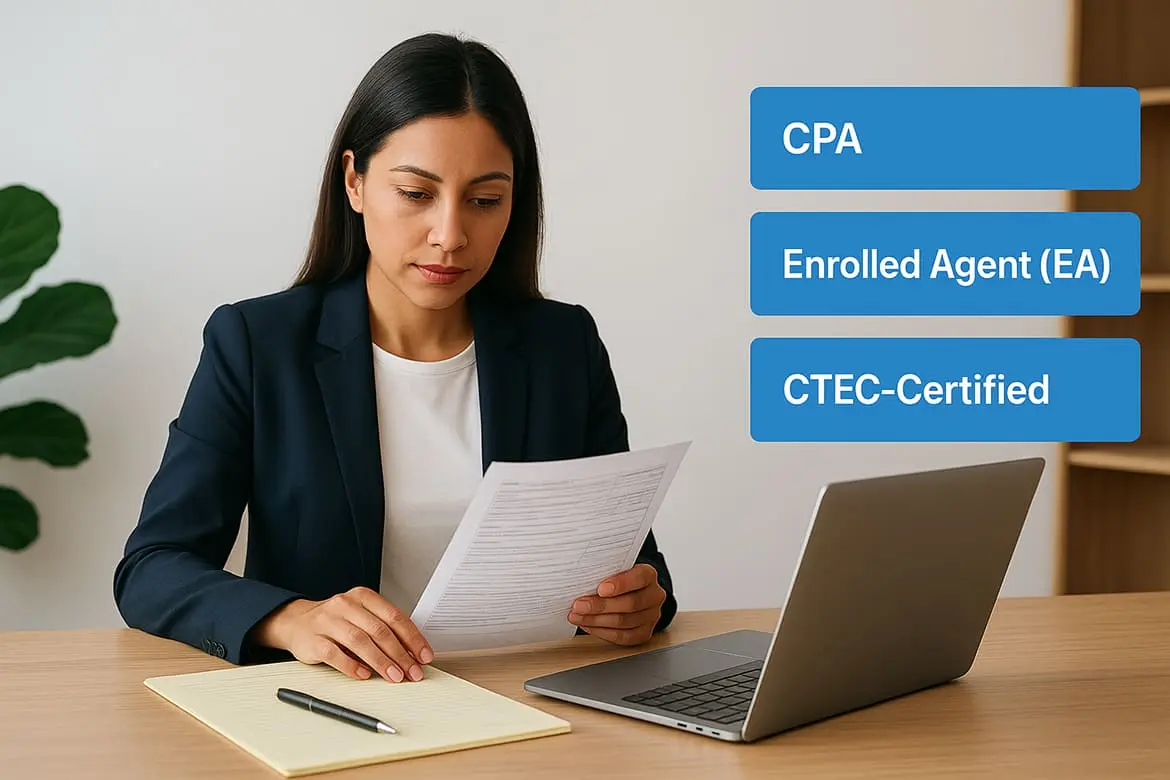
| Credential | Issued By | IRS Representation Rights |
|---|---|---|
| CPA | State licensing board | Full |
| Enrolled Agent (EA) | IRS | Full |
| CTEC-Certified | California (CTEC) | Limited |
| AFSP Participant | IRS | Limited |
Verify the PTIN and disciplinary record
Every paid preparer is required by law to hold a Preparer Tax Identification Number (PTIN), issued by the IRS. You can confirm your preparer holds an active PTIN through the IRS Return Preparer Office.
Skipping this verification step is one of the most common mistakes taxpayers make before signing anything.
Also confirm that no disciplinary actions or complaints exist by checking with your state's licensing board or the IRS Office of Professional Responsibility before you commit.
Step 3. Understand costs and what fees include
Tax preparation fees vary significantly based on your return complexity and the type of preparer you choose. Before you hire a tax preparer, knowing the typical price ranges helps you spot both a fair deal and a warning sign when one appears.
A preparer who quotes an unusually low flat fee may be cutting corners or planning to upsell you on additional services once you've already committed.
What typical fees look like
Most preparers charge by form or by complexity, not by the hour. Here's what you can generally expect across common filing situations:
| Filing Situation | Typical Fee Range |
|---|---|
| Simple W-2 return | $99 - $200 |
| Self-employed / Schedule C | $200 - $450 |
| Small business / S-Corp | $400 - $900+ |
| Amended return (1040-X) | $150 - $350 |
What your fee should cover
Your preparer's fee should include e-filing your federal return and, in most cases, your state return. Ask upfront whether state filing is bundled into the quoted price or billed separately.
Before agreeing to any number, clarify these points:
- Does the fee cover state return filing?
- Is IRS notice support included if something comes up after filing?
- Will the preparer review your prior-year return at no extra cost?
- Are correction fees waived if the preparer made the original error?
Step 4. Choose safely and get ready to file
Once you've verified credentials and confirmed fees, two steps remain before you sign anything: protecting yourself from bad actors and preparing your paperwork properly. Taking both seriously keeps the process smooth and puts you in control from the start.
Watch for red flags before you commit
A preparer who won't sign your completed return or refuses to include their PTIN is violating IRS rules. Walk away from anyone who promises a specific refund amount before looking at your documents. The following behaviors are warning signs:

A legitimate preparer earns your trust through transparency, not guarantees.
- Asks you to sign a blank return before it's completed
- Charges fees based on your refund size
- Declines to provide a copy of your filed return
- Has no physical address or verifiable credentials
Organize your documents before the appointment
Before you hire a tax preparer for your first session, gather everything in one place. Having your records ready reduces back-and-forth and speeds up your filing timeline significantly. Bring or upload:
- All W-2s, 1099s, and K-1s from the tax year
- Social Security cards or ITINs for you and any dependents
- Receipts, mileage logs, or records supporting deductions
- Bank routing and account numbers for direct deposit

Wrap-up and what to do now
Hiring a tax preparer comes down to three things: knowing your filing situation, verifying credentials, and understanding what your fee actually covers. If you take those steps before you sign anything, you'll avoid the most common mistakes taxpayers make when they hire a tax preparer in a hurry. The goal is to find someone who earns your trust through transparency, not promises.
Start by listing your income sources and gathering your documents. Then use the IRS directory to find credentialed professionals, confirm their PTIN, and ask direct questions about fees before committing. Every step in this guide exists to protect you from costly errors and unqualified preparers.
If you want a licensed, CTEC-certified professional to handle your return accurately and affordably, get your taxes filed with TaxesToday. With over 15 years of experience and services starting at $99, you get reliable filing without the stress.