


California FTB Form 568: Filing Steps, Deadlines, LLC Tax
Every California LLC, even one that didn't make a dime during the year, must file California FTB Form 568 with the Franchise Tax Board. Miss it, and you're looking at penalties, interest, and unwanted attention from the FTB. Whether you're a single-member LLC or a multi-member entity, this form is how California tracks your LLC's income, deductions, and annual tax or fee obligations.
Form 568 trips up a lot of business owners because it layers California-specific rules on top of federal requirements. You need to know which schedules to attach, how to calculate the LLC fee based on total income, and exactly when everything is due. Getting any of these wrong can cost you, sometimes more than the tax itself.
This guide walks you through the entire Form 568 process step by step: who needs to file, how to complete each section, what deadlines to watch, and how the LLC tax and fee are calculated. At TaxesToday, our CTEC-certified preparers have spent over 15 years helping California LLCs stay compliant and avoid costly filing mistakes. Below, we break down everything you need to handle Form 568 with confidence.
What California FTB Form 568 covers and why it matters
California FTB Form 568, officially titled "Limited Liability Company Return of Income," is the annual return that every California LLC must file with the Franchise Tax Board (FTB). It reports the LLC's total income, deductions, and credits, and it calculates the annual $800 minimum tax along with any LLC fee owed based on total income. Unlike the federal return you file with the IRS, this form is California-specific and follows state rules that often differ significantly from federal treatment.
What the form actually reports
Form 568 collects several categories of financial information about your LLC. The core of the return is a summary of income and expenses drawn from your federal filing, but California applies its own adjustments. You'll report total income from all sources, not just net income, which is what triggers the LLC fee calculation. The form also captures pass-through income allocated to each member, credits claimed, and withholding on nonresident members.
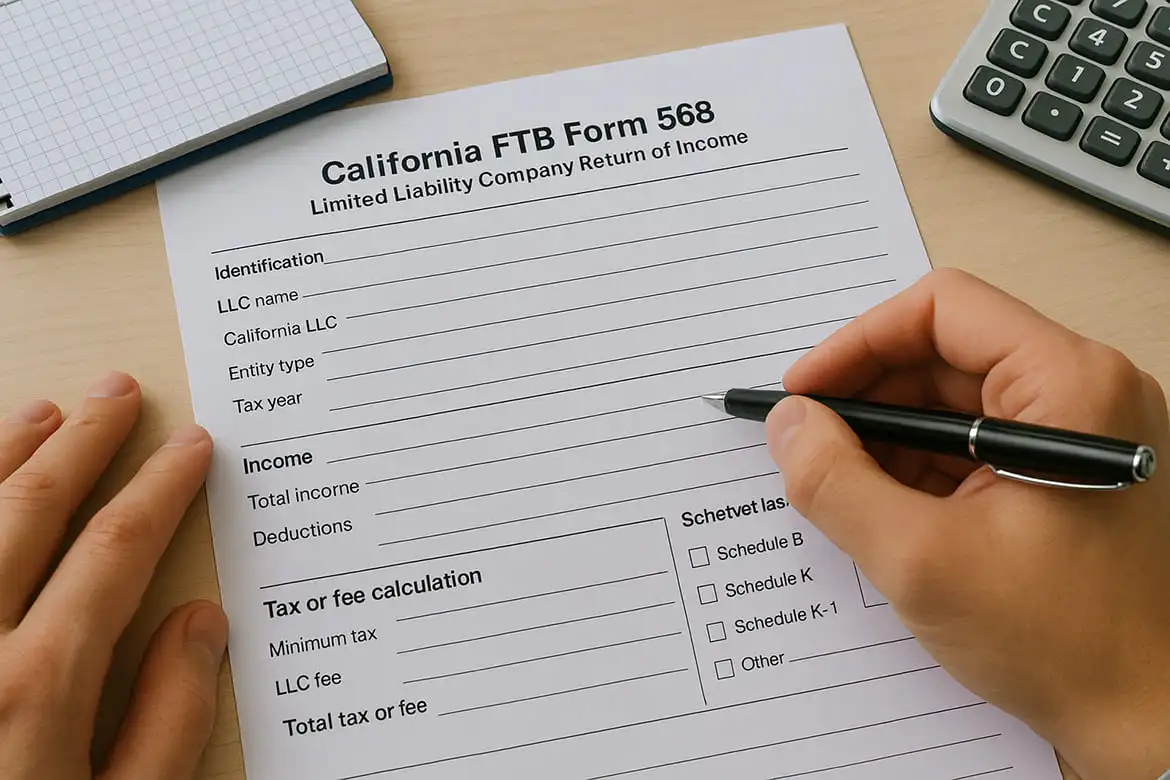
Here is a breakdown of the main items Form 568 covers:
| Section | What it captures |
|---|---|
| Side 1 (page 1) | LLC identification, tax year, entity type |
| Side 2 | Income, deductions, and tax or fee calculation |
| Schedule B | Detailed income and deductions |
| Schedule K | Members' shares of income, deductions, credits |
| Schedule K-1 (568) | Individual member allocation |
| Schedule IW | LLC income worksheet for fee calculation |
| Schedule T | Taxable-year income for first-year LLCs |
Why California treats LLCs differently
California is one of the few states that imposes both an annual minimum franchise tax of $800 and a variable LLC fee on top of federal requirements. The $800 tax applies regardless of whether your LLC earned any money or was even active during the tax year. If your LLC's total income reaches $250,000 or more, an additional LLC fee applies, scaling up to $11,790 for LLCs with total income of $5 million or more.
Every LLC registered or doing business in California owes the $800 annual minimum tax, even if the LLC had zero income or operated at a loss for the entire year.
This distinction matters because many LLC owners assume their federal return covers everything. It does not. California requires a completely separate state filing through Form 568, and the FTB tracks compliance independently from the IRS. If your LLC is registered in another state but earns income from California sources or conducts business here, you still have a Form 568 obligation.
Consequences of not filing or filing incorrectly
Skipping Form 568 or filing it late triggers an automatic $200 penalty per member for each month the return is overdue. That penalty accumulates fast, especially for multi-member LLCs. The FTB also charges interest on any unpaid tax or fee balance from the original due date forward.
Filing with errors creates its own complications. If you underreport total income on Schedule IW, the FTB may recalculate your LLC fee and issue a bill with added interest. If you fail to attach required schedules, your return can be treated as incomplete or invalid, and the FTB has authority to estimate your income and assess tax based on that estimate, which almost always produces a higher number than your actual liability.
Before you start: classify the LLC for tax filing
Before you open california ftb form 568, you need to know exactly how your LLC is classified for tax purposes. California determines which sections of Form 568 apply to your entity based on two things: the number of members in your LLC and how the IRS treats it at the federal level. Getting this wrong from the start means you may complete the wrong schedules or allocate income incorrectly to members.
Single-member vs. multi-member LLCs
A single-member LLC (SMLLC) is treated as a disregarded entity for federal tax purposes by default, meaning the IRS ignores it as a separate taxable entity. California respects this classification but still requires you to file Form 568 separately. Your SMLLC's income flows to your personal return on Schedule C, E, or F depending on the nature of the business, and you report that same income on Form 568 at the state level.
A multi-member LLC is treated as a partnership by default for federal purposes. California follows that treatment, which means the LLC files Form 568 as a partnership return and issues a Schedule K-1 (568) to each member showing their share of income, deductions, and credits.
| LLC type | Default federal treatment | Form 568 treatment |
|---|---|---|
| Single-member LLC | Disregarded entity | Files as SMLLC; income passes to owner |
| Multi-member LLC | Partnership | Files as partnership; issues K-1s to members |
| LLC taxed as S-Corp | S corporation | Files Form 100S instead; exempt from 568 |
| LLC taxed as C-Corp | C corporation | Files Form 100 instead; exempt from 568 |
How your federal tax classification affects Form 568
Your LLC's federal tax election changes which California return you file. If your LLC filed IRS Form 2553 to elect S corporation status or Form 8832 to elect C corporation status, California requires you to file Form 100S or Form 100 instead of Form 568. You do not file both.
If your LLC made a federal entity classification election, confirm that California also received notice of the election before assuming you are exempt from Form 568.
Confirming your classification before you start saves you from completing the wrong form entirely. Pull your most recent federal return and check the entity type listed on page one. That classification tells you which California return applies and which schedules inside Form 568 you need to complete.
Step 1. Confirm you must file Form 568 this year
Before you collect a single document, confirm that Form 568 is actually required for your LLC this tax year. California's filing rules are broad, and most LLCs registered or doing business in the state are required to file. There are, however, specific situations where a different return applies or where an exemption changes what you owe. Sorting this out now prevents you from completing the wrong form or missing an obligation entirely.
Who has a Form 568 filing obligation
Your LLC must file california ftb form 568 if it meets any of the following conditions during the tax year: it is organized in California, it is registered to do business in California as a foreign LLC, or it earns income from California sources even if it was formed in another state. The FTB looks at your actual activity, not just your registration address. If you sold goods to California customers, performed services in the state, or owned California real property, you almost certainly have a filing obligation regardless of where your LLC is chartered.
Use this checklist to confirm your situation before moving forward:
- LLC is organized under California law
- LLC is registered as a foreign LLC doing business in California
- LLC earned income from California sources during the year
- LLC is classified as a partnership or disregarded entity at the federal level
When you are not required to file Form 568
If your LLC elected to be taxed as an S corporation or C corporation at the federal level, you do not file Form 568. California requires those entities to file Form 100S or Form 100 respectively. Submitting Form 568 for a corporate-taxed LLC creates a duplicate filing the FTB will flag, and resolving it takes time that could have been avoided by confirming your classification upfront.
If you are unsure which California return applies to your LLC, check your most recent federal return for the entity classification box and match it to the table in the previous section before you proceed.
First-year LLCs and the tax waiver
California waives the $800 annual minimum tax for LLCs in their first taxable year if they were formed on or after January 1, 2021. This waiver applies only to the annual tax, not to the LLC fee. If your total income reached $250,000 or more in that first year, the LLC fee still applies. You still must file Form 568 for the first year even though no $800 tax is owed. Skipping the return because you assumed the waiver removed all obligations is one of the most common first-year mistakes that triggers FTB penalties.
Step 2. Gather the exact info you will report
Pulling together your documents before you start filling out california ftb form 568 saves you from stopping mid-return to track down missing numbers. The FTB requires specific figures that must match your federal return exactly, so you want your records organized and verified before you enter a single number on the form.
Financial records you need from the LLC
Your LLC's financial records are the foundation of Form 568. You need the profit and loss statement for the tax year along with your balance sheet as of the last day of the year. California starts the income calculation from your federal return figures and then applies state adjustments, so pull your completed federal return first. For a single-member LLC, that is typically Schedule C or Schedule E. For a multi-member LLC, it is Form 1065.
Gather these specific documents before you open Form 568:
- Federal return (Schedule C, E, or Form 1065 depending on LLC type)
- Profit and loss statement for the tax year
- Balance sheet as of the last day of the tax year
- Records of all California-source income earned during the year
- Prior year Form 568 if this is not your first filing
- Records of any estimated tax payments already made to the FTB
- LLC fee payment confirmations if you paid during the year
The LLC fee is based on total income from all sources, not net income, so you need gross income figures, not just your bottom-line profit number.
Member information and federal return details
For multi-member LLCs, you also need complete information for every member of the LLC. This includes each member's name, address, taxpayer identification number, ownership percentage, and residency status. California requires this data to generate accurate Schedule K-1 (568) forms and to determine whether nonresident withholding obligations apply.
Confirm whether any members are nonresident individuals, foreign entities, or other LLCs, because those categories trigger additional withholding and consent requirements you will address in Step 4. Having member details ready now means you won't need to pause and contact members while you're mid-way through the return. For the income allocation section, you also need each member's beginning and ending capital account balances, which come directly from the LLC's books and should match the figures on your federal partnership return if one was filed.
Step 3. Calculate the $800 annual tax and LLC fee
The two charges you calculate on california ftb form 568 are the $800 annual minimum tax and the LLC fee. These are separate obligations with different triggers, and confusing the two is one of the most common errors that leads to underpayment and FTB notices.
The $800 annual minimum tax
The $800 annual minimum tax is a flat charge that applies to nearly every California LLC, regardless of income or profit. You owe it whether your LLC made money, broke even, or operated at a loss for the entire year. The only exception is the first-year tax waiver available to LLCs formed on or after January 1, 2021, which eliminates the $800 charge in the initial taxable year only.
After that first year, the $800 applies with no exceptions and must be paid by the original due date of the return. Paying it on the extended deadline, rather than the original one, results in interest charges even if you filed a valid extension.
If you qualified for the first-year waiver last year, your $800 minimum tax starts with your second taxable year, regardless of whether your LLC earned any revenue.
The LLC fee based on total income
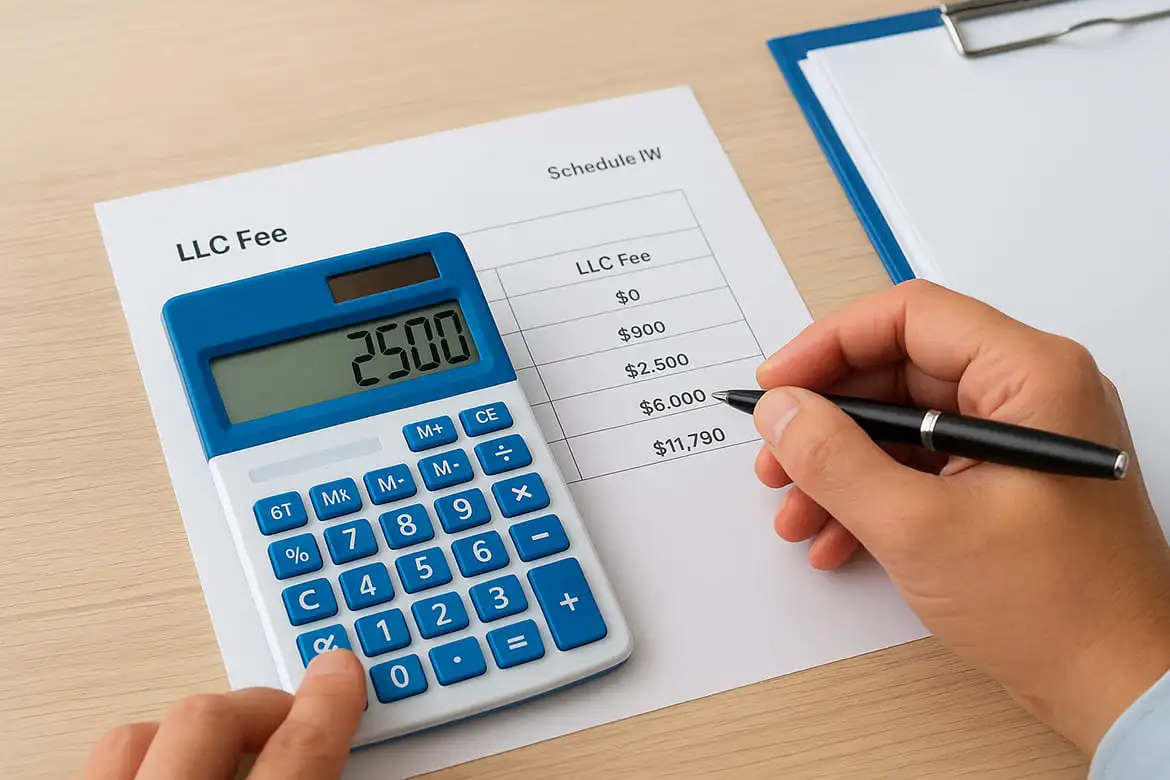
The LLC fee is an entirely separate charge tied to your total income from all sources, and "total income" means gross receipts, not net profit. You calculate it using Schedule IW, the income worksheet embedded in Form 568. The fee follows a fixed scale based on income brackets:
| Total income from all sources | LLC fee |
|---|---|
| Less than $250,000 | $0 |
| $250,000 to $499,999 | $900 |
| $500,000 to $999,999 | $2,500 |
| $1,000,000 to $4,999,999 | $6,000 |
| $5,000,000 or more | $11,790 |
How to complete Schedule IW
Schedule IW is a line-by-line worksheet you complete inside Form 568 before filling out Side 2. Start by entering your total California income from all sources, which includes income earned from other states if it flows through California operations. Add back any items California treats differently from the federal return, such as depreciation adjustments under state law.
Once you reach the final line of Schedule IW, match your total income figure to the fee table above and carry that amount to the LLC fee line on Side 2. Report the $800 annual minimum tax on a separate line from the LLC fee. The FTB verifies each charge independently, so combining them on one line will trigger a correction notice and delay your return.
Step 4. Handle nonresident members and required consents
If your LLC has any nonresident members, California imposes withholding and consent requirements that apply specifically at the state level. These obligations appear on california ftb form 568, and failing to address them correctly before you file creates a gap the FTB will catch and flag. Work through this step for every member who is not a California resident before you move to the schedules.
Withholding on nonresident individual members
California requires LLCs to withhold 7% of the nonresident member's distributive share of California-source income and remit it to the FTB on the member's behalf. This withholding applies to nonresident individuals, estates, and trusts receiving California income through the LLC. The LLC, not the individual member, is responsible for calculating, withholding, and remitting the correct amount.
Use this checklist to work through the withholding process for each nonresident member:
- Confirm the member's residency status using their address on file and prior year returns
- Calculate their California-source distributive share from your income allocation records
- Multiply that share by 7% to get the withholding amount
- Submit withholding payments using FTB Form 592 before the return due date
- Enter the withheld amount on the appropriate line of Form 568
If a nonresident member has already made estimated tax payments covering their California liability, they may provide documentation to reduce or eliminate the withholding requirement, but the LLC must retain that documentation in its records.
Consent agreements for foreign entities and nonresident members
Nonresident members who are foreign corporations, LLCs, or partnerships face a different requirement: they must sign a consent agreement stating they agree to California's tax jurisdiction. If a nonresident entity member refuses to sign, the LLC must withhold 8.84% of the member's distributable share of California net income instead of the standard rate that applies to individuals.
You attach the signed consent forms to Form 568 when you file. If a consent is missing, report that member's share separately and confirm the correct withholding rate is applied in the return. The FTB cross-checks member counts against the consent forms and withholding amounts reported, so a mismatch delays processing and can prompt an inquiry. Contact any nonresident entity members early in your preparation process to give them time to review and return the consent before your filing deadline.
Step 5. Complete Form 568 schedules and member reporting
With your income figures confirmed and nonresident member obligations addressed, you can now work through the schedules inside california ftb form 568. Each schedule feeds information into Side 2 of the return, so completing them in order prevents you from having to revise earlier figures when later numbers change.
Schedule B: income and deductions detail
Schedule B is where you report the LLC's income and deductions in full detail, broken out by category. Start with gross receipts or sales, then subtract returns and allowances to reach net sales. Work down through cost of goods sold, ordinary business income, rental income, and any other California-source income items. California follows federal income categories here but applies state-specific adjustments for items like depreciation differences under California law, so check each line against your federal return and note where California requires a different figure.
After completing the income section, carry total income from Schedule B to the LLC fee worksheet on Schedule IW to confirm your fee calculation matches what you entered in Step 3. Any discrepancy between Schedule B and Schedule IW will produce an incorrect fee on Side 2.
Schedule K and K-1 (568): allocating income to members
Schedule K summarizes the LLC's total income, deductions, credits, and other items that pass through to members. For a multi-member LLC, Schedule K is the source document for every individual Schedule K-1 (568) you issue to members. Fill in each line of Schedule K using the totals from Schedule B and any other applicable income categories before you start generating K-1 forms.
Each Schedule K-1 (568) must reflect that specific member's share of every item on Schedule K. Use the ownership percentages confirmed from your LLC operating agreement or any special allocation rules in place for the year. Include each member's:
- Name, address, and taxpayer identification number
- Beginning and ending capital account balances
- Distributive share of income, loss, deductions, and credits
- California withholding amount if the member is a nonresident
Issue each Schedule K-1 (568) to members before the filing deadline so they can report their California income correctly on their individual returns.
Once you have issued all K-1 forms, verify that the total of all members' allocated shares on the individual K-1s adds up exactly to the totals on Schedule K. A mismatch between K-1 totals and Schedule K is one of the most common errors the FTB identifies during return processing, and it will delay your return and trigger a correction notice.
Step 6. File and pay on time, including extensions
Knowing your filing deadline and payment due dates for california ftb form 568 is just as important as completing the return accurately. California separates the deadline to file from the deadline to pay, and conflating the two is a common mistake that generates interest charges even when you file a valid extension.
Standard deadlines for Form 568
For calendar-year LLCs, Form 568 is due on April 15 of the year following the close of your tax year. If your LLC operates on a fiscal year, the due date falls on the 15th day of the fourth month after your fiscal year ends. Both the $800 annual minimum tax and any LLC fee balance must be paid by the original due date, not the extended deadline. Paying either charge late results in interest accruing from April 15 forward, regardless of whether you filed an extension.
An extension gives you more time to file your return, not more time to pay. Any tax or fee balance you expect to owe must be remitted by the original April 15 deadline to avoid interest charges.
California also requires LLCs that expect to owe an LLC fee to make an estimated fee payment by June 15 of the current tax year using FTB Form 3536. If your total income will hit $250,000 or more for the year, you are responsible for this mid-year estimated payment. Skipping it triggers an underpayment penalty even if you pay the full fee when you file in April.
How to request and use a filing extension
California grants an automatic six-month extension to file Form 568. For a calendar-year LLC, that moves your filing deadline to October 15. You do not need to submit a separate extension request form to the FTB to get this extension. The extension applies automatically as long as you have paid at least the full amount of tax and fees owed by the original April 15 deadline.
Follow these steps to use the extension correctly:
- Calculate your estimated $800 tax and LLC fee before April 15 using your projected total income.
- Submit payment to the FTB by April 15 using your online FTB account or a check with the correct payment voucher.
- Complete Form 568 in full and file it by October 15.
- Retain proof of your April 15 payment in case the FTB sends a notice questioning your extension status.
If you miss the October 15 extended deadline, the automatic penalty of $200 per member per month begins to accumulate from that date forward, so set a calendar reminder well before the deadline arrives.
Step 7. Fix issues: late, amended, or final returns
Problems with california ftb form 568 don't fix themselves. Whether you missed a deadline, discovered an error after filing, or are closing your LLC for good, each situation requires a specific corrective action. Knowing what to do and acting quickly limits the financial damage and keeps the FTB from escalating the matter.
Filing or paying late
If you missed the April 15 or October 15 deadline, file Form 568 as soon as possible even if you cannot pay the full balance immediately. Continuing to wait increases the penalty that accumulates at $200 per member per month. When you file, attach a written explanation if you have reasonable cause for the delay, such as a documented medical emergency or a federally declared disaster. The FTB reviews penalty abatement requests on a case-by-case basis and may reduce or waive penalties if your explanation holds up.
Paying any amount you can on the day you file, even a partial payment, reduces the interest that accrues on the unpaid balance from the original due date forward.
Amending a previously filed return
If you find an error after you file, submit an amended Form 568 to correct it. Check the amended return box on Side 1 of the form and complete the return in full using the corrected figures. Do not attach only the lines that changed. The FTB requires a complete replacement return, not a partial correction. Include a written explanation of what changed and why on a separate sheet attached to the return.
Use this checklist to prepare an amended Form 568:
- Check the amended return box on Side 1 before entering any other data
- Recalculate every affected schedule using the corrected numbers
- Attach a brief written explanation identifying the error and the corrected figures
- Include any additional payment owed along with the amended return
- If the correction reduces your liability, include a written refund request
Filing a final return when closing your LLC
When you dissolve or cancel your LLC, you must file a final Form 568 for the last year of operation. Check the final return box on Side 1 and report income and expenses through the last day your LLC was active. California also requires you to file a Certificate of Cancellation or Certificate of Dissolution with the Secretary of State before or alongside your final return. Submitting the final Form 568 without completing the state dissolution process leaves your LLC technically active in California's records, and the $800 annual minimum tax continues to accrue each year until the FTB receives confirmation that the entity is formally dissolved.

Next steps
You now have a complete picture of how to handle california ftb form 568, from classifying your LLC and calculating the $800 annual tax and LLC fee, to filing on time and correcting mistakes after the fact. The process has real consequences if you get it wrong, and the FTB does not overlook missed returns or underpayments.
Your immediate actions should be to confirm your filing deadline, pull your federal return as the starting point for income figures, and verify whether any members trigger nonresident withholding obligations. If you already missed a deadline or discovered an error in a prior return, file as soon as possible to stop penalties from growing.
If your LLC's tax situation is more complex than a straightforward return, working with a licensed professional saves you more than it costs. The team at TaxesToday is ready to handle your return accurately and on time. Get your LLC taxes prepared by a CTEC-certified professional.